As artificial intelligence becomes the dominant technology within products, platforms and business processes, it is critical that companies understand what their AI systems can do — and, perhaps more importantly — what they can’t do. AI Red Teaming Services allow organizations to uncover failure modes, unexpected behaviors, unsafe outputs and attack vectors in their AI systems prior to release.
AI red teaming Services is a rigorous methodology that reveals the failure modes and unexpected behaviors of AI systems through adversarial examples. By challenging AI systems with extreme, misleading and unexpected inputs, red teams identify failure modes that would otherwise be difficult to detect.
For organizations that build large language models (LLMs), generative AI applications, conversational AI or products with embedded AI, red teaming can be an integral part of the model development and evaluation process.
What Is AI Red Teaming Services?
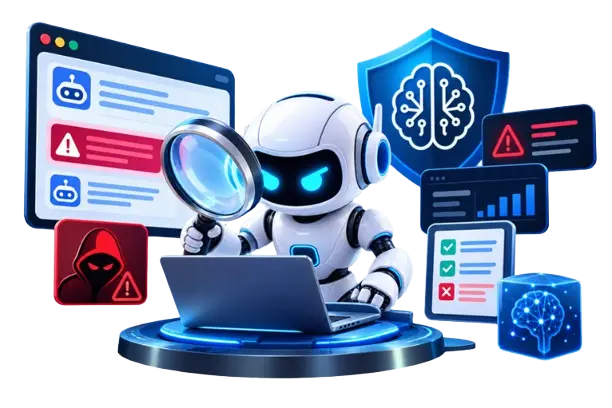
AI red teaming is an adversarial testing and evaluation process that reveals the failure modes and unexpected behaviors of AI systems.
Unlike traditional model testing and evaluation, which focuses on measuring performance on expected inputs, AI red teaming deliberately probes AI systems to identify failure modes and unexpected behaviors. Red teams test for common classes of model failure, including prompts that result in jailbreaking or unexpected model behaviors, unsafe or undesirable outputs, responses that reflect dangerous intent or information, instruction following failures, outputs containing sensitive information, model bias and other relevant classes of model failure.
Test results are compiled and shared with model developers, enabling them to refine model behavior and evaluation processes.
Why AI Red Teaming Matters
While traditional testing and evaluation is essential, it is typically performed on carefully curated test sets that represent only a subset of possible model behaviors. In contrast, real-world users will inevitably submit unexpected, ambiguous and even antagonistic prompts that cause models to behave in surprising ways
Adversarial testing and evaluation can be especially valuable in discovering failure modes that may not be apparent from standard testing and evaluation.
An AI red teaming program can enable organizations to:
• Find new AI model vulnerabilities
• Identify undesirable or unsafe model behaviors
• Evaluate the effectiveness of AI safety measures
• Assess model response to adversarial or unexpected prompts
• Determine jailbreaking and prompt manipulation capabilities
• Examine model hallucination and instruction following failures
• Provide remediation recommendations to model developers

How AI Red Teaming Works
A typical AI red teaming engagement begins with a discussion to determine the target model, use cases, failure modes of interest and evaluation criteria. Based on this information, evaluators design and execute a series of tests to probe the model’s capabilities and limitations.
Depending on the model, application, and industry, tests can include a mix of manual and automated approaches. After performing the tests, the red team evaluates the results to determine which represent true model failures and which are the result of expected model behaviors. The team compiles the relevant findings and shares them with the organization, along with recommendations for model improvements and continued red teaming.
Testing Large Language Models and Generative AI Systems
Large language models (LLMs) are incredibly powerful and versatile, but their emergent capabilities can also be quite dangerous. Because LLMs are so good at generating text “in context,” they are extremely challenging to evaluate using traditional software testing and quality assurance methodologies.
LLM red teaming can include testing for jailbreaking prompts, ambiguous or conflicting instructions, prompting techniques that reveal model capabilities or weaknesses, and other approaches that probe the model’s intent and behaviors.
For generative AI systems and applications, model evaluation can also include testing of retrieval-augmented systems, prompts, guardrails, agents, tools, and application logic. By examining the full stack of a generative AI application, organizations can more effectively identify risks and areas of concern.
Creating Better AI Applications
AI red teaming should not be considered a one-time exercise. As models, prompts, data, application logic and other factors evolve, new model behaviors and failure modes will inevitably emerge. By performing periodic AI red teaming assessments, organizations can more effectively manage the safety and security of their AI applications.
In addition, AI red teaming can be combined with other testing and evaluation approaches, including traditional benchmark testing, human evaluation, safety testing, and model auditing to create a more robust evaluation process.
Ensure AI System Readiness with Adversarial Testing
The potential of AI systems can be difficult to realize without first fully understanding their limitations and dangers. AI Red Teaming Services allow organizations to take a proactive approach to AI risk management by exposing their AI systems to adversarial testing and evaluation.
From LLM applications and generative AI systems to custom AI applications and products, red teaming can help organizations better understand their AI systems’ safety, security and capabilities.