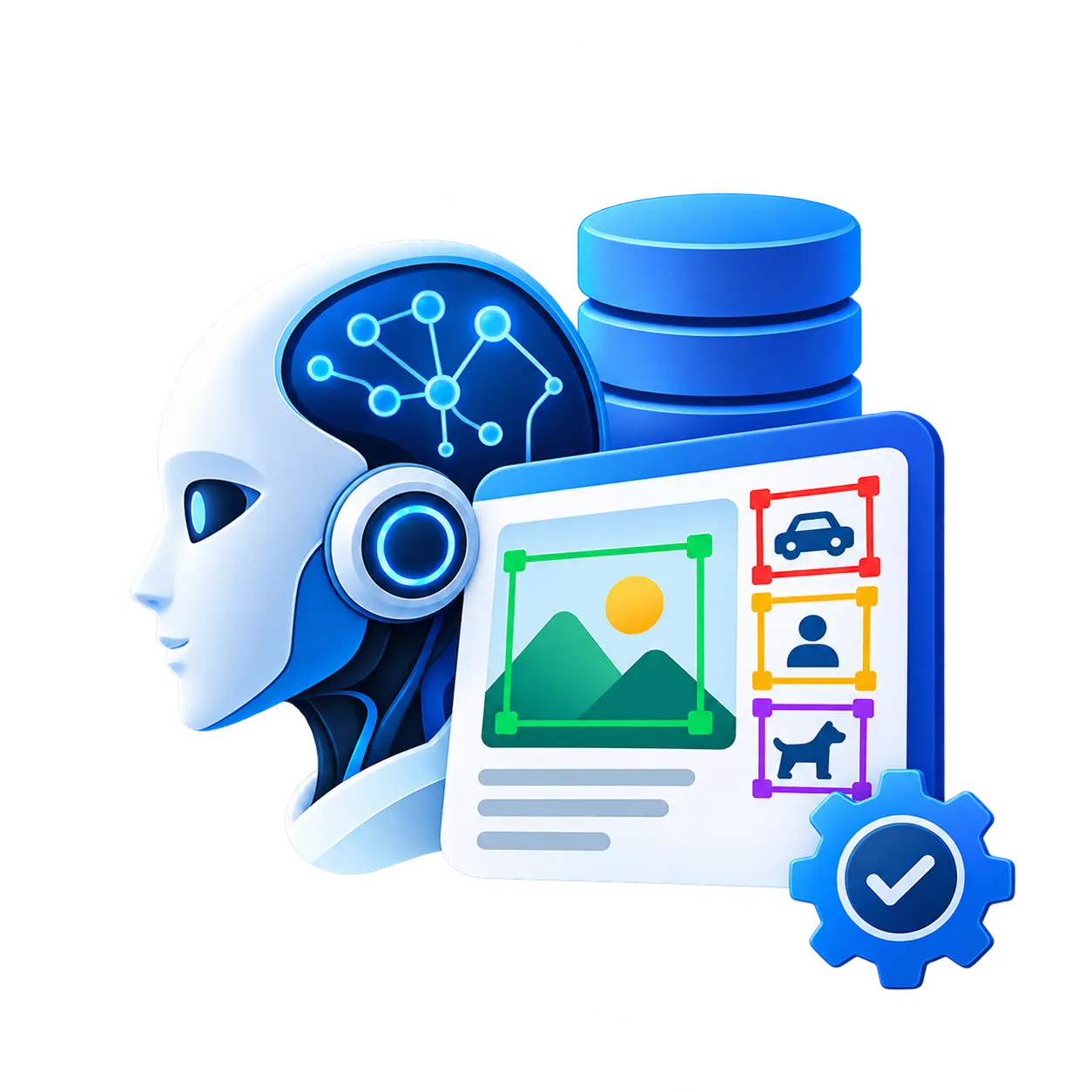
Accurate Data Annotation Services
for Smarter AI Development
Boost AI performance with precise data annotation services, including image, text, video, and audio annotation for reliable models.
Talk to an AI Data ExpertProfessional Data Annotation Services to Power Accurate, Scalable, and High-Performance AI Machine Learning Models
Book a Strategy SessionOur Data Annotation Services help businesses build reliable AI and machine learning models with high-quality, accurately labeled datasets. We provide image annotation, video annotation, text annotation, audio annotation, image classification, object detection, and semantic segmentation. With expert annotators, rigorous quality checks, and scalable workflows, we deliver consistent training data designed to improve model accuracy, efficiency, and real-world performance.
Comprehensive Data Annotation Services for
AI Development
IMAGE & VIDEO
ANNOTATION
Create accurate visual datasets for computer vision using image classification, object detection, bounding boxes, segmentation, tracking, and video annotation.
Read More
TEXT ANNOTATION &
NER
Transform unstructured text into AI-ready datasets through NER, classification, intent detection, sentiment analysis, and entity tagging.
Read More
SPEECH & AUDIO
ANNOTATION
Build high-quality speech datasets with transcription, speaker diarization, timestamping, phonetic tagging, and audio classification.
Read More
DOCUMENT
ANNOTATION
Convert complex documents into structured datasets using OCR, layout annotation, table extraction, entity recognition, and document classification.
Read MoreImage & Video Annotation
Transform raw visual data into structured, high-quality training datasets with precise annotation designed for advanced AI and machine learning applications.
Bounding Boxes
Precisely identify objects and regions within visual datasets.
Segmentation
Create detailed pixel-level labels for complex visual data.
Keypoints
Mark important points for pose and object recognition.
Tracking
Follow objects accurately across multiple video frames.
Image Annotation Services
We deliver accurate image annotation solutions that transform unstructured visual data into high-quality training datasets for computer vision and AI applications. Our annotation workflows help machine learning systems recognize objects, understand scenes, and make reliable predictions.
- Image Classification
- Object Detection
- Image Segmentation
- Polygon Annotation
- Keypoint Annotation
- OCR & Text Annotation
- Facial Landmark Annotation
Video Annotation Services
Our video annotation solutions help AI systems understand movement, objects, activities, and interactions across video sequences. We combine frame-level precision with rigorous quality control to create dependable datasets for computer vision, surveillance, robotics, autonomous systems, and intelligent video applications.
- Object Tracking
- Video Classification
- Action Recognition
- Motion Annotation
- Pose Estimation
- Lane Detection
- Frame-by-Frame Annotation
Transform Text Into AI-Ready Data
Convert unstructured language into accurate, structured data for AI, NLP and machine learning models through expert text annotation.
NER
Identify names, organizations, locations and key entities.
Classification
Organize text into meaningful and machine-readable categories.
Intent
Understand user requests, actions and conversational intent.
Sentiment
Detect opinions, emotions and sentiment within written content.
Make Every Voice Machine-Readable
Transform speech into structured, AI-ready datasets with precise transcription, speaker identification, timestamps and phonetic annotation.
Transform Documents Into Structured Intelligence
Our Data Annotation Services turn complex documents into structured, machine-readable datasets using accurate OCR, layout annotation, table extraction, entity recognition and document classification.
Annotation Pipeline
OCR
Extract printed and scanned text accurately.
Layout
Preserve document structure and reading order.
Tables
Annotate rows, columns, cells and relationships.
Entities
Identify names, dates, organizations and key data.
Document Classification
Categorize documents for intelligent processing.
High-Fidelity Training Modalities
Purpose-built data environments tailored to the precise architecture of your foundation models.

Text & Conversational
AI
Structuring complex multi-turn dialogue, logic-based reasoning chains (CoT), and deep linguistic alignment for global and sovereign LLMs.
Read More ♧
Vision & Spatial AI
Engineering pixel-perfect 2D/3D sensor fusion, semantic segmentation, and LiDAR point clouds for advanced perception systems.
Read More ♧
Speech & Audio
Intelligence
Architecting multi-speaker diarization, phonetic tagging, and studio-grade voice corpora across 200+ global dialects.
Read More ♧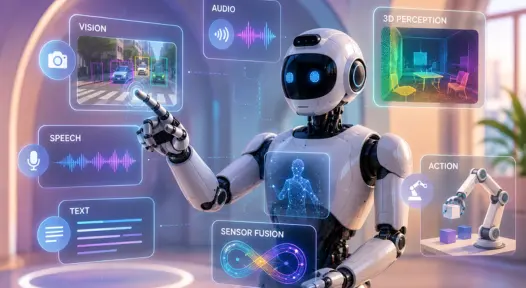
Multimodal &
Embodied AI
Bridging text, vision, and sensor inputs to train highly accurate agentic workflows and real-world automated systems.
Read More ♧Enterprise Data Governance
Built on a strict zero-trust architecture to protect mission-critical IP at every stage of the AI lifecycle.
Regulatory Alignment
Operating under strict NDAs, GDPR compliance, and ISO-certified frameworks to ensure absolute global data sovereignty and risk mitigation.
Deterministic Quality Control
Executing multi-tier validation and Expert-in-the-Loop (HITL) consensus to guarantee hallucination-free, highly accurate training data.
Secure Infrastructure
Utilizing SOC-compliant workflows, air-gapped processing environments, and federated data pipelines to permanently eliminate data leakage.
Frequently Asked Questions
Have questions? We’re here to help. Here are some of our most common queries.
RLHF (Reinforcement Learning from Human Feedback), DPO (Direct Preference Optimization), and Preference Optimization are advanced techniques used in Generative AI Training to improve the quality, accuracy, and alignment of large language models. RLHF trains AI models using human feedback by rewarding preferred responses and discouraging poor ones, helping models generate more useful and context-aware outputs. DPO simplifies this process by learning directly from ranked human preferences without requiring a separate reward model, making optimization more efficient. Preference Optimization focuses on teaching AI systems to consistently produce responses that align with human expectations, improving reasoning, helpfulness, and overall user experience during LLM Training.
These methods rely on expert human data annotation, where annotators compare, rank, and evaluate multiple AI-generated responses based on accuracy, relevance, safety, and clarity. The collected feedback is used to refine model behavior, reduce hallucinations, minimize bias, and improve response consistency. Combined with Supervised Fine-Tuning (SFT) and AI model evaluation, RLHF, DPO, and Preference Optimization enable organizations to build reliable, trustworthy, and high-performing Generative AI models that deliver accurate and human-aligned results across diverse applications.
RLHF (Reinforcement Learning from Human Feedback) and DPO (Direct Preference Optimization) play a vital role in Generative AI Training by helping large language models produce responses that are more accurate, relevant, and aligned with human expectations. While pre-trained models learn from vast amounts of data, they still require human guidance to improve reasoning, reduce factual errors, and deliver context-aware answers. RLHF uses human feedback to reward preferred responses, whereas DPO directly learns from ranked human preferences, making the optimization process more efficient. Together, these methods significantly enhance the quality and reliability of LLM Training across a wide range of real-world applications.
Human data annotation is at the core of both RLHF and DPO, as expert annotators evaluate, compare, and rank multiple AI-generated responses based on accuracy, clarity, safety, and usefulness. This continuous feedback helps reduce hallucinations, minimize bias, improve consistency, and strengthen model alignment with user intent. Combined with Supervised Fine-Tuning (SFT) and AI model evaluation, RLHF and DPO enable organizations to develop trustworthy, high-performing Generative AI models that deliver safe, reliable, and human-centric experiences across industries and languages.
RLHF (Reinforcement Learning from Human Feedback) and DPO (Direct Preference Optimization) services are designed to improve the accuracy, safety, and alignment of AI models throughout the Generative AI Training lifecycle. These services include prompt creation, response ranking, preference annotation, pairwise comparison, quality evaluation, safety assessment, and structured human feedback. Expert annotators review AI-generated outputs to identify the most accurate, relevant, and contextually appropriate responses. This high-quality feedback helps refine LLM Training by improving reasoning, reducing hallucinations, and ensuring models generate reliable and human-aligned outputs across diverse domains and languages.
A comprehensive RLHF and DPO workflow also includes Supervised Fine-Tuning (SFT) support, AI model evaluation, bias detection, content moderation, and continuous quality assurance. Human reviewers validate annotations through multi-level quality checks to maintain consistency and accuracy at scale. These services enable organizations to optimize model performance, improve response quality, and enhance user satisfaction while meeting ethical AI standards. By combining expert human data annotation with rigorous evaluation processes, businesses can build trustworthy, scalable, and high-performing Generative AI models for enterprise and consumer applications.
Yes, multilingual RLHF (Reinforcement Learning from Human Feedback) and preference data collection are essential for developing Generative AI Training models that perform accurately across multiple languages and cultures. Native-language experts evaluate, compare, and rank AI-generated responses based on accuracy, fluency, cultural relevance, and contextual understanding. This human feedback helps large language models learn language-specific nuances, regional expressions, and user preferences that cannot be captured through automated processes alone. High-quality multilingual datasets improve LLM Training by enabling AI systems to generate natural, reliable, and context-aware responses for global users across diverse industries and markets.
A scalable multilingual annotation workflow includes preference ranking, pairwise comparisons, prompt evaluation, safety reviews, and rigorous quality assurance to ensure consistent results across languages. Human annotators also support Direct Preference Optimization (DPO), Supervised Fine-Tuning (SFT), and AI model evaluation by identifying the most helpful, accurate, and culturally appropriate responses. This continuous human feedback reduces bias, minimizes hallucinations, and improves model alignment with user expectations. As a result, organizations can build trustworthy, multilingual Generative AI solutions that deliver high-quality experiences across different languages, regions, and real-world applications.
High-quality RLHF (Reinforcement Learning from Human Feedback) and DPO (Direct Preference Optimization) datasets are built through well-defined annotation guidelines, expert human annotators, and rigorous quality assurance processes. Every task follows standardized instructions to ensure consistency when evaluating, comparing, and ranking AI-generated responses. Multi-level reviews, validation checks, and expert audits help identify inaccuracies and maintain annotation quality across large datasets. Native-language specialists and domain experts further improve the reliability of Generative AI Training by providing accurate, context-aware, and culturally relevant feedback that strengthens LLM Training and enhances model performance across different industries and languages.
Quality is continuously improved through human-in-the-loop workflows, ongoing reviewer calibration, and performance monitoring. Annotators assess responses for accuracy, relevance, clarity, safety, and alignment with user intent, while quality teams measure agreement scores and refine annotation guidelines when needed. These processes support Supervised Fine-Tuning (SFT), AI model evaluation, and preference optimization, helping reduce hallucinations, minimize bias, and improve reasoning capabilities. By combining expert human data annotation with scalable quality control, organizations can create reliable RLHF and DPO datasets that enable trustworthy, high-performing Generative AI models.
Let’s Get On A Discovery Call
Ready to Scale Your
AI Infrastructure?
Connect with our data architecture team to discuss your proprietary model requirements.